Guide
Dura Fast 40 vs Franklin X-40
Two balls own the outdoor game, and they do not play the same. Here is what each maker publishes, what an independent test actually measured, and how to pick without buying both.
By Stephen V. · Updated October 2026 · How we pick
The short answer
Buy the Franklin X-40 if the player is a recreational or improving player, plays social doubles, or uses a control paddle. Buy the Dura Fast 40 if the player is a competitive 4.0-and-up player who wants a fast ball, plays with a power paddle, or is practicing for a tournament that uses it. If you are buying as a gift and you do not know which, buy the Franklin — it is the more forgiving ball and the one more recreational courts actually use.
That is the whole decision, and it rests on one measured difference rather than a long list of them. Both balls have 40 holes. Both are one-piece seamless outdoor balls. Both are listed as approved by USA Pickleball. What separates them is how hard the plastic is, and that single property drives the speed, the feel off the paddle and the way each ball ages.
If you want the broader field rather than this pairing, our best outdoor pickleball balls roundup ranks the category, and indoor vs outdoor pickleballs covers the more fundamental mistake — buying the wrong type entirely.
The honest limits of this comparison
Nobody on this site has played with either ball. There is no testing program behind Popaddle, no instrumented rig, no court-side notes and no hitting panel — and a comparison that invented them would be worth less than one that says plainly what it is. What follows is every figure the two makers and their specialist retailers publish, read against USA Pickleball's own equipment standards, plus the measurements from one independent test that put both balls on the same apparatus.
That independent test is Pickleball Science, which measured stiffness on both balls with the same apparatus it uses across its ball articles, played them with aggressive 3.5 players at roughly four doubles games an hour, and checked for cracks under a microscope. It is worth knowing two things about the source: it does not name an author, and it discloses that some of its links are affiliate links. We are citing it because it is the only side-by-side measurement of these two balls we could find, and because its numbers are specific enough to be checked. Our how we pick page explains what we do and do not do, and it applies here without exception.
One figure to flag rather than bury. Pickleball Science reported both balls at 0.95 oz when new, which sits slightly above the 0.935 oz ceiling published in USA Pickleball's Equipment Standards Manual. That is a discrepancy, not a verdict: one scale is not a certification lab, retailer-published weights for these balls disagree with each other too, and the authoritative answer to "is this ball legal" lives in USA Pickleball's approved equipment database rather than in anyone's article. We are reporting the number as measured and naming the conflict instead of quietly picking whichever figure reads better.
What the two balls actually are
The Dura Fast 40 is the older institution. It is sold under the Onix brand, and its specialist retail listing describes a "40 hole pattern," "one-piece seamless construction" and "Onix's specific formula of plastic." The same listing calls it "USAPA approved for tournament play" and "the official ball of the USAPA," and claims it "is used in more sanctioned tournaments than any other pickle ball on the market." It is sold in 4-packs, dozens and bulk boxes, and the yellow is by far the most common.
The Franklin X-40 is the mass-market one, and it is also a tournament ball. Franklin's specialist retail listing describes "one-piece, rotationally molded" balls with a "Seamless, one-piece design" and single-sized precision-drilled holes, "designed for enhanced durability with 40 holes." It is published as "USAP Approved" and as the "Official Ball of US Open Pickleball Championships," sold in 3, 6, 12 and 100 count, in optic yellow plus pink, ember and lava. You will also see it sold as the "X Performance 40" — that is the same ball under its previous branding, which matters when you are comparing listings.
So the marketing positions are closer than the folklore suggests. Both are tournament balls. Both are seamless and one-piece. Both have 40 holes. The idea that one is "the serious ball" and the other is "the cheap ball" does not survive either specification sheet, and the real difference is in the plastic.
The published specifications, side by side
These are the figures the two balls' specialist retail listings publish, with USA Pickleball's own permitted ranges alongside for context. Where a listing does not publish a figure, this table says so rather than borrowing one from somewhere else.
Two things stand out. First, the Franklin listing contradicts itself on weight — "approximately 0.88 ounces" in the description and "26 grams" in the specification block, which is about 0.92 oz. Both numbers are inside the rulebook range, so nothing is wrong; it is a reminder that published ball weights are loosely kept. Second, the Dura listing publishes neither a diameter nor a weight, which is exactly why the independent measurement in the next section is worth having.
What an independent test measured
Pickleball Science put both balls on the same stiffness apparatus and then played them to destruction. These are its reported figures.
The article is explicit that it is not recommending one ball over the other and that the choice comes down to preference. It also says plainly that it has not proven smaller holes are more aerodynamic, while noting the Dura "might have a slight edge" there — which is the right way to report an untested hunch, and we are repeating it as one.
Stiffness is the whole difference
A stiffer ball deforms less when the paddle hits it, so more of the energy comes back out as speed. That is why the measured 130 lb/in against 94 lb/in matters more than any other line in the table: a 40% stiffness gap is a different game, not a different flavor. Shots come back faster, hands battles at the net get quicker, and a player who is still working on reaction time has less of it.
The same property changes the soft game in the opposite direction. A stiffer ball sits on the face for less time, which gives a player less of the dwell that a drop shot or a dink relies on. That is the mechanical reason behind the pairing Pickleball Science suggests — the stiff Dura with a power paddle, the softer X-40 with a control paddle — and it is the same logic the site uses in best control paddles and best power paddles. Ball and paddle are one system. A fast ball on a power paddle is a very fast combination.
There is one more consequence worth saying out loud, because it is the most practical thing on this page. A ball that holds its stiffness plays the same on game thirty as on game one, and a ball that softens quickly does not. The X-40 losing roughly 10% of its stiffness every four games means a dozen that starts as a medium ball finishes as a slow one — which is fine for recreational play, and genuinely bad for anyone trying to practice at a consistent speed.
Durability, and what "it lasts longer" really means
Both balls cracked at about the same point: roughly 30 games under aggressive 3.5 play in that test. So the familiar claim that one of these balls is far more durable than the other does not hold up in the one side-by-side measurement we can cite — at least not on time-to-crack.
What differs is how each ball behaves on the way there. The Dura kept its stiffness almost entirely intact until it cracked, losing 8% across 32 games. The X-40 developed soft spots after about three hours of play — roughly twelve games — and became too soft to measure reliably after that, although the testers kept using those balls for recreational play well beyond another twelve games. So the Dura's advantage is consistency, not lifespan, and the X-40's failure mode is going soft rather than breaking.
Which of those two failures costs you more depends entirely on what you are doing. For tournament preparation, a ball that changes speed mid-session is the worse problem. For a Saturday morning group that plays until a ball cracks, a ball that gets a little slower is not a problem at all. We go into the wider question on how long pickleball balls last, and the short version is that outdoor balls are a consumable: budget for them like tennis balls, not like equipment.
Color, cold weather and the things the specs do not cover
Visibility is the practical difference the specification sheets do not address, and it favors Franklin. The X-40 is published in optic yellow plus pink, ember and lava, while the Dura Fast 40 is sold in yellow and neon. If the player has trouble picking the ball up against a light court surface or plays in the late afternoon, having actual color choices is worth more than any measurement on this page.
Cold weather is the folklore item, and here we can only report what the listings say. The Dura listing claims the ball maintains "a round shape, along with consistent performance in a range of court temperatures." The Franklin listing claims the ball "withstands hours of the most aggressive play." Neither publishes a temperature range, neither quantifies anything, and the independent test did not test cold. Outdoor balls do get brittle in the cold — that is well-known to anyone who plays through a winter — but we have no sourced figure for either ball and will not invent one.
Last: approval. Both are published as USA Pickleball approved, but approval attaches to a specific ball and revision and it does move. If the player competes in sanctioned events, the thirty seconds spent looking the ball up in USA Pickleball's equipment database is worth more than any article, including this one. The rulebook requires the ball used in sanctioned play to be on that list.
Which one to buy
Buy the Franklin X-40for a recreational or improving player, for social doubles, for a player using a control paddle, for anyone who wants a color other than yellow, and for any gift where you do not know the recipient's level. It is the medium-speed ball, it is the more forgiving one, and it is published as the official ball of the US Open — so nobody can tell you it is not a serious ball.
Buy the Dura Fast 40 for a competitive player who has asked for a fast ball, for someone drilling with a power paddle, for anyone practicing for a tournament that uses it, and for a player who cares that the ball plays identically from the first game to the last. Its listing claims it is used in more sanctioned tournaments than any other ball, and the measured stiffness consistency is the real reason serious players reach for it.
Buy a 3-pack first if you genuinely do not know. Outdoor balls are a consumable and a three-ball sleeve costs about what a cup of coffee and a pastry does. Two sleeves — one of each — settles the argument for less than the difference between two dozens, and whichever one they prefer, nothing is wasted. If you are assembling a larger present, our pickleball starter kit checklist puts balls in context against the rest of the spend.
The gear this guide points to
Disclosure: Popaddle earns a commission on qualifying purchases made through the links on this page, at no extra cost to you. Prices are pulled live and can change. How this works.
| # | Product | Best for | Price |
|---|---|---|---|
| 1 | 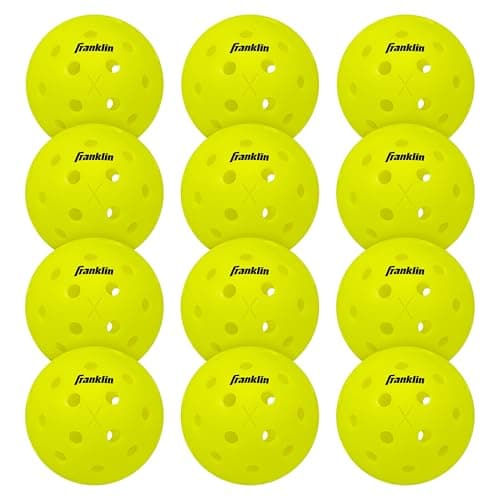 Franklin X-40 Performance Outdoor Pickleballs (12-Pack) The medium-speed ball of the two, published as the official ball of the US Open, in a dozen. | Recreational and improving players, social doubles, control paddles | $17.40 · View on Amazon $39.99 save 56% |
| 2 | 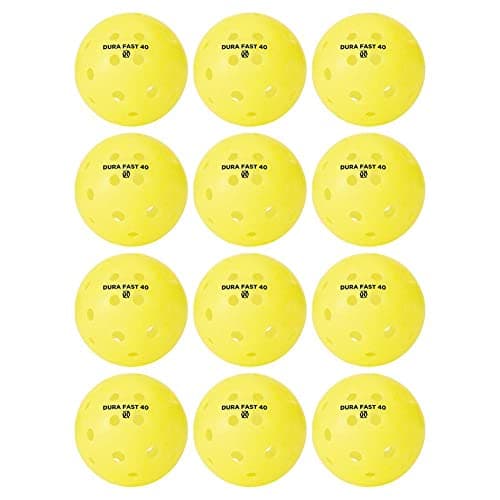 Dura Fast 40 Outdoor Pickleballs (Dozen) The stiffer, faster ball - measured at about 130 lb/in new and it holds that almost to the crack. | 4.0-plus players, power paddles, tournament preparation | |
| 3 | 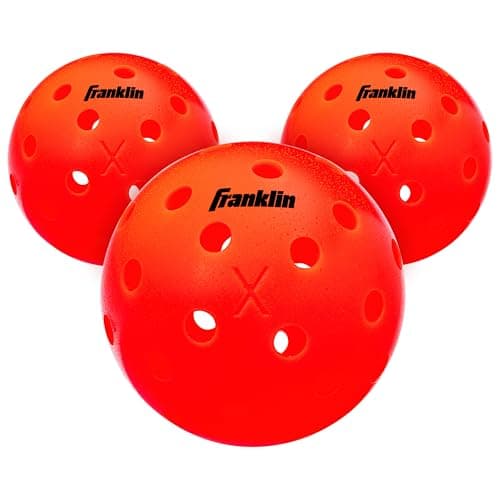 Franklin X-40 Tournament Pickleballs (3-Pack, Ember) A three-ball sleeve of the Franklin in ember - the cheap way to test a ball, and the visible way to play at dusk. | Settling the argument cheaply, or playing in poor light | $4.99 · View on Amazon $7.99 save 38% |
Franklin X-40 Performance Outdoor Pickleballs (12-Pack)
Best for: Recreational and improving players, social doubles, control paddles
This is the default outdoor ball and the one to buy when you do not know the player's level. Pickleball Science measured it at about 94 lb/in new against the Dura's 130 lb/in, and characterizes it as a medium-speed ball suited to most recreational players in roughly the 3.0-4.0 band and best paired with control paddles. The listing publishes 40 precision-drilled single-sized holes, a one-piece rotationally molded seamless build, a 2.91 in diameter and USAP approval, plus its status as the official ball of the US Open Pickleball Championships. A dozen is the sensible quantity: outdoor balls are a consumable, not equipment.
Skip it if: Skip it if the player is drilling and wants a ball that plays the same all session - this one lost about 10% of its stiffness every four games in that test and developed soft spots from around game twelve. Skip it too if their court or league specifies the Dura, which plenty do.
Dura Fast 40 Outdoor Pickleballs (Dozen)
Best for: 4.0-plus players, power paddles, tournament preparation
Buy this one for a player who has told you they want a fast ball, or who is practicing for an event that uses it. Pickleball Science measured it at about 130 lb/in new, called it "almost 40% stiffer" than the X-40, characterized it as a fast ball suited to intermediate-to-advanced players, and paired it with power paddles. Its real advantage showed up over time: it lost only 8% of its stiffness across 32 games, so the ball plays the same at the end of a session as at the start. The listing publishes a 40-hole pattern, one-piece seamless construction in Onix's own plastic formula, USAPA tournament approval, and the claim that it is used in more sanctioned tournaments than any other ball.
Skip it if: Skip it for a beginner outright - that same test notes beginners may not benefit from it, and a faster ball gives a developing player less time to react. Skip it too if the player uses a control paddle and plays a soft game; a stiff ball sits on the face for less time, which is the opposite of what a dink game wants.
Price as of November 22, 2026. #ad · how this works
Franklin X-40 Tournament Pickleballs (3-Pack, Ember)
Best for: Settling the argument cheaply, or playing in poor light
This is the pick that saves you from guessing. A three-ball sleeve costs a fraction of a dozen, so buying one of each ball and playing a session is a cheaper experiment than committing to twelve of the wrong one. The ember color is the second reason: the X-40 is published in optic, pink, ember and lava, and a non-yellow ball is genuinely easier to track against a pale court or in late-afternoon light - the one real advantage Franklin has over the Dura that no measurement on this page captures. The listing publishes USAPA tournament approval, precision-drilled holes and durable polyethylene construction.
Skip it if: Skip it if you already know which ball you want - three balls is a week of play for a regular group and the dozen is better value per ball. Skip it too if the player's league specifies a ball color, as some indoor-outdoor facilities do.
Frequently asked questions
Which ball is faster, the Dura Fast 40 or the Franklin X-40?
The Dura Fast 40, and the gap is large. Pickleball Science measured the Dura at about 130 lb/in of stiffness when new against about 94 lb/in for the X-40 - "almost 40% stiffer" in its own words - and a stiffer ball deforms less on impact, so more energy comes back out as speed. The same article characterizes the Dura as a fast ball and the X-40 as a medium-speed ball. For a developing player that difference means less reaction time, which is the main reason to start with the Franklin.
Which ball lasts longer?
On time-to-crack, neither - both cracked at around 30 games in the one side-by-side test we can cite, played by aggressive 3.5 players. What differs is how they age before that. The Dura held its stiffness almost completely, losing 8% across 32 games. The X-40 developed soft spots at about twelve games and softened fast, around 10% every four games, though the testers kept using those balls recreationally well beyond that. So the Dura's advantage is consistency rather than lifespan.
Are both balls USA Pickleball approved?
Both are published as approved - the Dura listing says "USAPA approved for tournament play" and the Franklin says "USAP Approved" - and the rulebook requires the ball used in sanctioned play to be on the approved list. But approval attaches to a specific ball and revision and it changes, so if the player competes, look the exact ball up in USA Pickleball's own equipment database rather than trusting any article. That is a thirty-second check and it is the only current answer.
How many holes does each ball have?
Forty, both of them - the hole count is not the difference, despite being the thing both names advertise. What does differ is hole size and pattern. Pickleball Science measured the Dura with 0.26 in holes beside the equatorial seam and 0.32 in holes in the next row, against a uniform roughly 0.29 in on the Franklin, giving total open hole areas of 2.56 and 2.64 square inches. The article speculates the Dura "might have a slight edge" aerodynamically and is explicit that it has not proven it.
Can I use either of these balls indoors?
You can, and you should not. Outdoor balls are harder with smaller holes and they are built for wind and rough surfaces; indoor balls are softer with fewer, larger holes and are built for a smooth gym floor. Playing an outdoor ball indoors is loud, fast and hard on the body, and playing an indoor ball outdoors means the first gust decides the point. We cover the split properly on our indoor vs outdoor pickleballs guide - it is the more consequential choice than this one.
Why do published weights for these balls disagree?
Because ball weight is loosely published and loosely controlled within a permitted band. USA Pickleball's Equipment Standards Manual allows 0.78 to 0.935 oz. Franklin's own specialist listing says "approximately 0.88 ounces" in one place and "26 grams" - about 0.92 oz - in another. Pickleball Science weighed both balls at 0.95 oz new, slightly above the published ceiling. All of those can be true of different individual balls from different batches; it is a reason to treat any single published weight as indicative rather than exact.
Does the ball matter as much as the paddle?
Not as much, but more than most players think, and they interact. A stiff, fast ball on a power paddle is a very fast combination, and a soft ball on a control paddle is a very slow one - which is why Pickleball Science pairs the Dura with power paddles and the X-40 with control paddles. The ball is also far cheaper to change. If a player feels the game is too fast, switching from a Dura to an X-40 costs a few dollars and is a more sensible first move than buying a different paddle.
Which should I buy as a gift?
The Franklin X-40, unless the recipient has specifically asked for the Dura. It is the medium-speed ball, it suits the widest range of levels, it comes in colors that are easier to see, and it carries the US Open official-ball line so it never reads as the budget option. Buy a dozen if they play weekly; buy a three-pack as an add-on to a bag, a paddle or a pair of shoes. Balls are the most reliably useful pickleball gift there is, because every player loses them and every player cracks them.
Keep exploring
The whole category ranked, beyond this pairing.
Indoor vs outdoor pickleballsThe more consequential choice than this one.
How long do pickleball balls last?Why outdoor balls are a consumable.
Best pickleball ballsIndoor and outdoor in one shortlist.
How many pickleballs do I need?How to size the order before you buy a dozen.
Best control paddlesThe paddle this test pairs with the X-40.
Best power paddlesThe paddle this test pairs with the Dura.
Best pickleball caddiesWhere a dozen balls actually lives.
Best pickleball bags for womenBags with a ball pocket that actually holds three.
Sources
- Pickleball Science — DuraFast 40 vs Franklin X-40 Pickleballs (measured: both 0.95 oz new; 40 holes each; DuraFast holes 0.26 in beside the seam and 0.32 in in the next row vs a uniform ~0.29 in on the X-40; open hole area 2.56 sq in vs 2.64 sq in; new stiffness ~130 lb/in vs ~94 lb/in, "almost 40% stiffer"; DuraFast lost 8% stiffness over 32 games, the X-40 about 10% every four games; both cracked at about 30 games; the site discloses affiliate links and tested with aggressive 3.5 players)
- Pickleball Warehouse — Dura Fast 40 Outdoor Pickleballs listing (brand Onix; "40 hole pattern"; "one-piece seamless construction"; "Onix's specific formula of plastic"; "USAPA approved for tournament play" and "the official ball of the USAPA"; "used in more sanctioned tournaments than any other pickle ball on the market"; "consistent performance in a range of court temperatures")
- Pickleball Central — Franklin X-40 Performance Outdoor Pickleballs listing ("one-piece, rotationally molded"; "Seamless, one-piece design"; "designed for enhanced durability with 40 holes"; single-sized precision-drilled holes; "They measure 2.91\" in diameter"; "weigh approximately 0.88 ounces" in the description and "Weight: 26 grams" in the specification block; "USAP Approved"; "Official Ball of US Open Pickleball Championships"; available in 3, 6, 12 and 100 count; Made in China)
- USA Pickleball — Equipment Standards Manual (2.D.3 size: ball diameter 2.87-2.97 in / 2.874-2.972 in, maximum out-of-round variance +/-0.020 in; 2.D.4 weight 0.78-0.935 oz / 22.1-26.5 g; 2.D.5 bounce 30-34 in to the top of the ball)
- USA Pickleball — Official Rulebook (rule 2.D ball specifications; 2.D.1 the ball must be on the approved list for sanctioned play)
- USA Pickleball — Approved equipment database (which balls and paddles are approved for sanctioned play)
Browse another way