Guide
Pickleball Court vs Tennis Court
One is 880 square feet, the other 2,808. Here is every official figure from both rulebooks side by side - including the net heights, which are not the numbers most people guess.
By Stephen V. · Updated October 2026 · How we pick
Both courts, side by side
Every number below is published by the sport's own governing body — the USA Pickleball rulebook for pickleball, the ITF Rules of Tennis for tennis. Nothing here is estimated, and where a rule states both imperial and metric figures, both are given.
The headline is the one everybody expects: a tennis doubles court covers a little over three times the playing area of a pickleball court. That single fact explains most of why pickleball spread as fast as it did — far more people can cover 880 square feet than 2,808, and a sport you can still play at sixty is a sport with a much larger possible population.
The less obvious difference is in the lines. A tennis court is divided a long way back from the net: the service line sits 21 feet from it, and everything between is in play from the first shot. A pickleball court puts its most important line 7 feet from the net — the non-volley zone, which USA Pickleball describes as "the 14-foot area around the net (7 feet on each side)" and which everyone calls the kitchen. You cannot volley from inside it. That one rule is the reason pickleball rallies look the way they do, and it has no equivalent in tennis. Our pickleball court dimensions page sets out the full pickleball layout, line by line.
Why the net heights are not the numbers people guess
This is the sub-question people actually search for, and the answer has two parts. First: neither net is flat. Both sports hang the net from a cord between two posts and then hold it down at the middle, so both nets dip. Second: they dip by different amounts, which means there is no single "net height" for either sport.
Pickleball's net is 36 inches at the sidelines and 34 inches at the center — a 2-inch dip. Tennis hangs its net from posts at 1.07 m, which is 3 feet 6 inches, and the rules require it to be 0.914 m — 3 feet, or 36 inches — at the center. That is a 6-inch dip, three times pickleball's.
Put those together and you get the only fact from this page worth memorizing: a pickleball net at the sideline is exactly as high as a tennis net at its lowest point. Both are 36 inches. If you have ever stood at a tennis net and thought a pickleball net looked similar, that is why — at the middle of the court, where you are standing, pickleball's net is 2 inches lower than tennis's. The gap only opens up as you walk toward the sideline, where tennis climbs to 42 inches and pickleball stays at 36.
Why the dip exists at all is simple engineering: a cord strung between two posts under tension cannot be made perfectly level, so rather than fight it, both rulebooks specify the sag. A portable net that sags more than its specification is a net whose tensioning system has given up, which is the single most useful thing to know when choosing one.
Playing pickleball on a tennis court: what the arithmetic says
This is where most people arrive from, so here is the honest version. A pickleball court is 20 by 44 feet. A tennis court inside its doubles lines is 36 by 78. So a single pickleball court drops inside a tennis court with 16 feet of width and 34 feet of length left over — it fits comfortably, with the pickleball sidelines well inside the tennis singles lines and a lot of room behind each baseline.
Two pickleball courts side by side is a different sum. Two 20-foot widths need 40 feet, and the tennis doubles court is 36 feet wide. They do not fit between the doubles lines, which means any two-across layout has to use the apron outside the tennis lines — and how much apron a court has is a property of the facility, not of the rulebook. We are not going to quote you a courts-per-tennis-court number, because the number depends entirely on the fenced area a particular club happens to have, and no figure for it is published in either rulebook. If you are planning a conversion rather than a weekend game, measure your own fence line.
For a weekend game, the practical answer is much shorter. You need a net 22 feet wide — pickleball's rule is that the net must span at least 21 feet 9 inches post to post, which is why every portable net sold for the sport is 22 feet. You need something to mark lines, because the tennis lines underneath will not help you: nothing on a tennis court sits where a pickleball line needs to sit, and the kitchen line in particular has no tennis equivalent. Chalk works on an outdoor hard court and washes off. Vinyl line tape works indoors and on smooth surfaces. And you need permission, which on a public court usually means checking whether pickleball is allowed before you set up, because a tennis net already standing in the middle of the court is not a problem you can solve with tape.
One thing you do not need to change is the surface or your shoes, which is the next section.
Surface, shoes and the one thing that transfers
Both sports are played on the same kinds of hard surface — acrylic-coated asphalt or concrete outdoors, wood or synthetic indoors — which is exactly why tennis courts get converted and why the two sports keep arguing over the same municipal real estate. There is no pickleball-specific surface requirement that a tennis court fails.
Footwear transfers in the same way. A court shoe built for tennis is built for the thing that matters in both sports: lateral support. Harvard Health Publishing is blunt about where the risk in pickleball sits — "sudden starts and stops and side-to-side moves increase stress on joints, muscles, and ligaments" — and the American Podiatric Medical Association recommends sport-specific shoes that support quick changes of direction. A running shoe does neither; it is built to roll forward, and it is the single most common equipment mistake a new pickleball player makes. Our pickleball shoes vs tennis shoes guide covers how close the two categories really are, and our best pickleball shoes roundup is the buying page.
What does not transfer is the swing. A tennis player arriving at pickleball brings a long stroke to a sport played with a paddle the rulebook caps at 17 inches and a hollow plastic ball, and the adjustment is real — it is why we keep a separate paddles for tennis players page, built around elongated shapes and longer handles. If you are reading this because somebody in your house plays tennis and is curious about pickleball, that page and our pickleball vs tennis comparison are the two to read next.
One more piece of tennis equipment deserves its own warning, because it is the expensive one. A ball machine does NOT transfer the way the court and the shoes do: a pickleball is wider than a tennis ball and weighs well under half as much, which is the worst combination for a feed path built around the other shape. Our page on using a tennis ball machine for pickleball has the governing-body numbers and the fifteen-minute test that settles it for your specific machine.
What to buy if the court you have is a tennis court
The equipment list is short, and the net is the whole of it. Everything below spans the 22 feet pickleball's rules require, and the choice between them comes down to how often the net goes up and down and who has to carry it. If you want the full field rather than the three picks here, our best portable pickleball nets page covers every net in this registry and our nets and ball machines page adds practice equipment.
A note on what we are not recommending: line tape and court chalk. Both are the right answer for marking a court, neither is a product we currently carry a verified listing for, and we would rather say so than point you at something we have not checked. Buy whichever marking product your surface takes — chalk outdoors, vinyl tape indoors — and spend your attention on the net.
The gear this guide points to
Disclosure: Popaddle earns a commission on qualifying purchases made through the links on this page, at no extra cost to you. Prices are pulled live and can change. How this works.
| # | Product | Best for | Price |
|---|---|---|---|
| 1 |  BAGAIL Portable Pickleball Net Set with Wheels A 22 ft regulation net with wheels that also sets up at 11 ft for half-court practice. | A tennis court or driveway where the net goes up and comes down each time | $71.99 · View on Amazon $79.99 save 10% |
| 2 |  Pro Pickleball Net with Wheels A 22 ft tournament-size net with a hand-crank tension system and locking wheels. | A court where the net stays up and sag is the enemy | $142.99 · View on Amazon $198.99 save 28% |
| 3 | 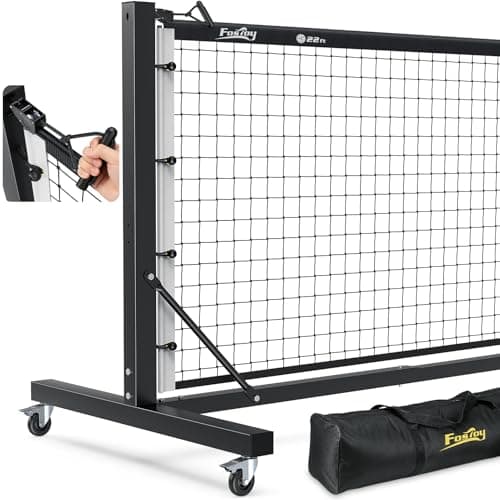 Fostoy Pickleball Net An aluminum-framed net with a dual-side tensioning system. | A permanent setup where tension has to hold from both ends | $199.99 · View on Amazon $219.99 save 9% |
| 4 | 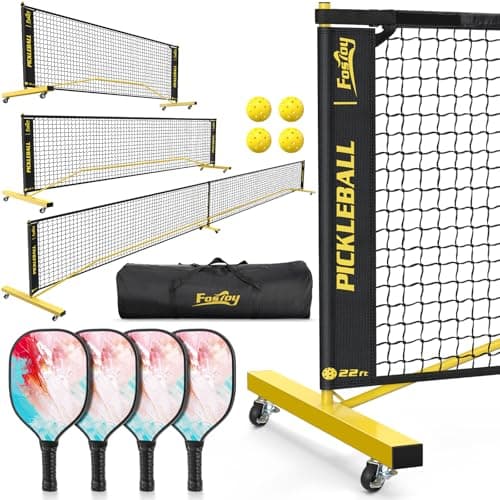 Pickleball Set Net with 4 Paddles A net plus four paddles and balls, with 6 ft, 11 ft and 22 ft configurations. | Turning up to a tennis court with nothing and leaving able to play | $104.99 · View on Amazon $119.99 save 13% |
BAGAIL Portable Pickleball Net Set with Wheels
Best for: A tennis court or driveway where the net goes up and comes down each time
This is the net to buy if the court is not yours. It spans the 22 feet the rules call for, it rolls on wheels rather than being carried, and the listing specifies a second 11-foot half-court configuration — which is what you want when only two of you turn up, or when the far half of the tennis court is occupied by people playing tennis. It packs into a carry bag, which matters more than it sounds for anybody loading a net into a car twice a week.
Skip it if: Skip it if the net will live permanently on one court, where a heavier frame will hold its tension better over a season. Skip it too if you need a net that stays up in wind - a portable frame on a wheeled base is a compromise by design.
Pro Pickleball Net with Wheels
Best for: A court where the net stays up and sag is the enemy
The specification that matters on a net is the one that stops it sagging, and this listing is built around it: a hand-crank tensioning system, a heavy-duty frame described as anti-sag, and locking wheels so the whole thing rolls into position and then stays there. For a club, a school or a household that has effectively adopted one tennis court, this is the right level of net - the one that still measures 34 inches at the center in March after going up in October.
Skip it if: Skip it if you are carrying the net anywhere on foot or storing it in a closet; substance means weight. Skip it too if this is a trial run rather than a commitment - it is the most expensive way on this page to find out whether you like playing on the local tennis court.
Fostoy Pickleball Net
Best for: A permanent setup where tension has to hold from both ends
An aluminum frame is lighter than steel at the same stiffness and does not rust, which is the right trade for a net that lives outdoors on a converted court. The listing's dual-side tensioning is the other half of the same idea: tensioning from both ends rather than one keeps the dip even across the span, which is exactly the specification the rulebook cares about. This is the pick for the buyer who has decided the pickleball court is now permanent.
Skip it if: Skip it on price if you are equipping more than one court - the all-round pick above gets you playing for a good deal less. Skip it too if portability is the point; a frame built to hold tension is not a frame built to be carried.
Pickleball Set Net with 4 Paddles
Best for: Turning up to a tennis court with nothing and leaving able to play
If nobody in the group owns a paddle, this is the single purchase that fixes everything: the listing includes four paddles and balls alongside the net, and the net itself sets up at 6, 11 or 22 feet, so it works as a full court, a half court or a child's practice setup. For a family that wants to use the empty tennis court at the end of the street, buying one box beats buying four things.
Skip it if: Skip it if anyone in the group already plays, because the paddles included are starter-grade and will be the first thing replaced - our paddles under $50 page covers better pairs at a similar price. Skip the kit too if you only need the net; you are paying for paddles you may not want.
Frequently asked questions
How much smaller is a pickleball court than a tennis court?
A pickleball court is 20 by 44 feet, which is 880 square feet inside the lines. A tennis doubles court is 36 by 78 feet, or 2,808 square feet. So the tennis court is a little over three times the area. The length difference is the one players feel most: 44 feet against 78 means the back of a pickleball court is barely further from the net than a tennis service line is.
Is a pickleball net the same height as a tennis net?
No, and neither net is one height. Pickleball's net is 36 inches at the sidelines and 34 inches at the center. Tennis hangs its net from posts at 3 feet 6 inches (1.07 m) and requires 3 feet (0.914 m) at the center. The useful coincidence is that a pickleball net at the sideline and a tennis net at the center are both 36 inches - which is why the two look more alike from the middle of the court than the numbers suggest.
Can you play pickleball on a tennis court?
Yes, and it is the most common way people play outside dedicated facilities. A pickleball court fits inside the tennis doubles lines with room to spare. What you need is a portable net spanning 22 feet, because pickleball's net must be at least 21 feet 9 inches post to post, and something to mark the lines - chalk outdoors, vinyl tape on a smooth indoor surface. The tennis lines underneath are no help: nothing on a tennis court sits where a pickleball line needs to be.
How many pickleball courts fit on one tennis court?
It depends on how much space sits outside the tennis lines, and we are not going to invent a number. Here is the arithmetic you can rely on: one pickleball court fits inside the doubles lines with 16 feet of width and 34 feet of length left over. Two courts side by side need 40 feet of width, which is more than the 36-foot doubles width, so a two-across layout has to use the apron outside the lines. Neither rulebook publishes a conversion figure, so if you are planning a real conversion, measure your fence line rather than trusting a number from an article.
Can you use the tennis lines to play pickleball?
Not usefully. The service line on a tennis court is 21 feet from the net; pickleball's non-volley line is 7 feet from the net, and the non-volley zone has no tennis equivalent at all. The sidelines are wrong too - 36 feet against 20. People do play improvised games inside tennis lines, but the kitchen rule is the heart of pickleball and you cannot approximate it with a line fourteen feet too far back.
Do you need different shoes for pickleball and tennis?
Not really - a court shoe works for both, which is why so many players own one pair. Both sports punish a shoe that cannot handle lateral movement, and both reward a stable, flat, grippy sole. The APMA recommends sport-specific shoes that support quick changes of direction, and Harvard Health is explicit that pickleball's side-to-side movement is where the joint stress comes from. The shoe you must not wear is a running shoe, in either sport.
Is the court surface different?
No. Both sports are played on the same hard surfaces: acrylic-coated asphalt or concrete outdoors, wood or synthetic indoors. There is no pickleball-specific surface requirement that a tennis court fails to meet, which is exactly why conversions are so common and why the two sports end up competing for the same municipal courts.
Keep exploring
Every official pickleball figure, line by line.
Pickleball vs tennisThe full sport comparison: scoring, equipment, play.
Best portable pickleball netsEvery 22 ft net we have verified.
Pickleball shoes vs tennis shoesHow much of a tennis shoe transfers.
Best paddles for tennis playersElongated shapes and longer handles.
Best nets and ball machinesIf the court is becoming a practice setup.
Pickleball vs badmintonThe closest relative on court footprint.
Best paddles under $50Cheap pairs to go with the net.
Sources
- International Tennis Federation — Rules of Tennis 2026, Rule 1 (court 78 ft / 23.77 m long, 27 ft / 8.23 m wide for singles and 36 ft / 10.97 m for doubles; net posts at 1.07 m; net 0.914 m at the center; service lines 21 ft / 6.40 m from the net; doubles net posts 3 ft / 0.914 m outside the court)
- USA Pickleball — Official Rulebook, Section 2 (court 20 x 44 ft, net 36 in at the sidelines and 34 in at the center, net at least 21 ft 9 in post to post; 2.E.3 paddle size 24 in combined, 17 in maximum length; 2.E.4 no weight restriction)
- USA Pickleball — How to Play ("The Non-Volley Zone (NVZ), nicknamed the Kitchen, is the 14-foot area around the net (7 feet on each side)")
- Harvard Health Publishing — Practical pointers for pickleballers ("sudden starts and stops and side-to-side moves increase stress on joints, muscles, and ligaments"; players aged 50+)
- American Podiatric Medical Association — Choosing Shoes for Sports (sport-specific shoes; support through quick changes of direction)
Browse another way